
Kusajataka
Kusajataka
In the ancient kingdom of Kasi, nestled amidst rolling hills and fertile plains, ruled a king named Brahmadatta. He was a just ruler, beloved by his people, but his heart was troubled by a peculiar affliction. He suffered from an unbearable sadness, a melancholy that would descend upon him without cause, casting a dark pall over his days.
The king's physicians were baffled. They tried every remedy known to them, from potent herbs to soothing music, but nothing could alleviate his profound sorrow. The court physicians, after much deliberation, suggested a radical approach. 'Your Majesty,' they advised, 'it is said that the touch of Kusa grass, when imbued with the purest of intentions and the deepest of compassion, has the power to heal even the most afflicted soul. We suggest you seek out a sage who cultivates such qualities and ask for his blessing.'
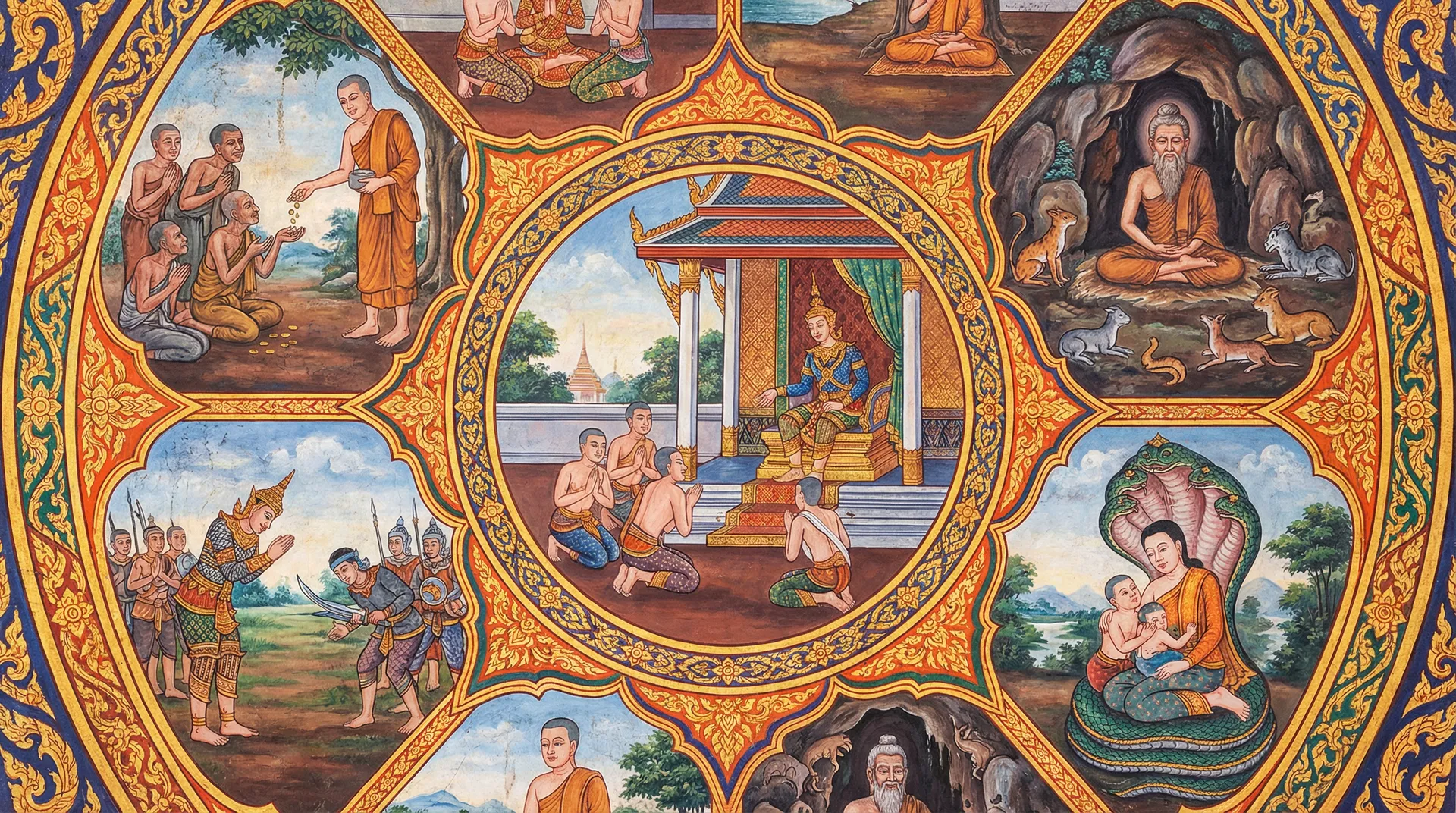
The king, desperate, agreed. He sent emissaries throughout the land, searching for a sage of unparalleled virtue. Their search led them to a secluded forest, where lived an ascetic named Kusa. This ascetic was not merely a hermit; he was a Bodhisatta, one who had dedicated countless lives to the perfection of compassion. His very presence radiated peace, and his touch was said to bring solace to all beings.
The king's emissaries found Kusa in his humble abode, meditating beneath a sacred banyan tree. They explained their king's plight, their voices filled with the urgency of their mission. Kusa, with his boundless compassion, immediately understood. He agreed to help, not for any personal gain, but for the alleviation of suffering.
Kusa, accompanied by the emissaries, journeyed to the capital of Kasi. Upon his arrival, the king, weak and dispirited, was brought before him. Kusa, with a gentle smile, approached the king. He gathered a handful of the finest Kusa grass, whispering prayers of peace and well-being into its blades. Then, with the utmost care and tenderness, he laid the grass upon the king's chest.
The moment the Kusa grass touched the king, a wave of warmth spread through him. The oppressive sadness that had held him captive for so long began to recede. It was as if a heavy veil had been lifted from his heart, and the light of joy began to stream in. The king felt a profound sense of peace and lightness he had not experienced in years.
'Ascetic Kusa,' the king exclaimed, his voice filled with wonder and gratitude, 'you have performed a miracle! You have lifted a burden that no one else could touch. How is it that your touch, and this simple grass, possess such power?'
Kusa smiled serenely. 'Your Majesty,' he replied, 'the power lies not in the grass itself, nor solely in my touch, but in the purity of intention and the boundless compassion that accompanies it. My life has been dedicated to cultivating such qualities. I have learned that true healing comes not from external remedies alone, but from the inner transformation that arises from a heart filled with selfless love and understanding.'
He continued, 'The sorrow you feel is a reflection of attachments and unresolved burdens within the mind. By offering this grass with pure compassion, I have sought to remind your heart of its innate capacity for joy and peace. The Kusa grass is merely a conduit, a symbol of the purity that resides within all beings, waiting to be awakened.'
King Brahmadatta was deeply moved by Kusa's wisdom. He realized that his sadness was not merely a physical ailment, but a manifestation of deeper emotional and spiritual imbalances. He spent many days with Kusa, learning from his teachings on mindfulness, detachment, and the cultivation of compassion.
Under Kusa's guidance, the king began to understand the nature of suffering and the path to its cessation. He learned to observe his thoughts without judgment, to let go of past regrets, and to embrace the present moment with gratitude. He found that by actively practicing compassion towards his subjects and all living beings, his own inner peace grew exponentially.
Eventually, the king's melancholy completely vanished, replaced by a radiant joy and a deep sense of contentment. He became an even more beloved ruler, known for his kindness, wisdom, and profound empathy. He often referred back to the ascetic Kusa, attributing his transformation to the Bodhisatta's selfless act of compassion.
The story of Kusa and the healing grass became a legend, a testament to the extraordinary power of compassion and pure intention. It taught the people of Kasi that the greatest remedies for suffering often lie not in external cures, but in the cultivation of inner virtues, the awakening of a benevolent heart, and the unwavering commitment to alleviating the pain of others.
— In-Article Ad —
💡Moral of the Story
True healing and lasting happiness come from cultivating inner virtues like compassion, selfless love, and mindfulness. Our intentions and the purity of our heart are powerful forces for transformation.
Perfection: Compassion (Karuna) and Generosity (Dana)
— Ad Space (728x90) —
More Jataka Tales You May Enjoy
 46Ekanipāta
The Bodhisatta as the Weaver Bird
The Bodhisatta as the Weaver BirdIn the lush green canopy of a sprawling banyan tree, where sunlight...
💡 Diligence, honesty, and compassion are the foundations of true security and a virtuous life.
 373Pañcakanipāta
Virochana Jātaka
Virochana JātakaIn the magnificent city of Mithila, ruled a king named Vidhura, a monarch whose reig...
💡 True power resides not in external possessions or magical artifacts, but in inner wisdom, self-control, and freedom from attachment.
131EkanipātaMugapakkha Jataka
The Tale of the Mute Prince In the ancient kingdom of Varanasi, nestled beside the sacred Ganges, li...
💡 True wisdom often lies not in speaking, but in knowing when and how to speak, especially when words are needed to uphold truth and compassion.
29EkanipātaThe Bodhisatta as a Fish
The Bodhisatta as a FishIn the tranquil depths of a vast and ancient lake, where the water was as cl...
💡 True leadership, guided by wisdom and compassion, inspires courage and unity to overcome daunting challenges.
52EkanipātaThe Bodhisatta as the King of the Pigeons
The Bodhisatta as the King of the PigeonsIn the bustling heart of a vibrant city, where grand palace...
💡 The power of truth, even from the humblest of sources, can overcome deceit and injustice, leading to righteousness.
165DukanipātaMahasattva Jataka
The Bodhisatta's Compassion for the Hungry TigressIn the vast, untamed wilderness of the Himalayas, ...
💡 The highest form of compassion is selfless sacrifice, willing to give one's own life for the well-being of others, even for animals, to alleviate suffering and demonstrate ultimate love.
— Multiplex Ad —